Friday, June 12, 2015

2015-13 Navajo Lake to Durango Colorado

2015-13

Navajo Lake New Mexico:  continued
Durango Colorado

Campground:  Navajo Lake St Pk:  see previous report

La Plata County Fairgrounds
Campground:  La Palata County Fairgrounds, Durango Co.  $16.50 elect/water, no dump station.  Only 6 Rv sites available.  Nice river walk from fairgrounds to downtown Durango.  Strong Verizon cell phone signal and about 6 over-the-air tv stations.


After visiting Chaco Canyon, I could have visited a number of other pueblo/Great House sites that are also in the area.  Salmon Ruins and Aztec being the two that are close by.  Even though I’ve been to both of them in the past, I did return to Aztec Ruins again.  It is considered an outlying settlement of Chaco Canyon and many of the techniques in design and building of the two Great Houses can be attributed to the same Chaco Canyon influences.

a Kiva that has been completed reconstructed
using much of the original stonework
unusual design with 12 outer rooms overlooking the Kiva interior

The most unusual aspect of the two Great Houses (only one has been partially excavated) is it’s large Kiva.  Around the exterior, are a dozen rooms with high windows which look down into the main Kiva.  The Kiva has been completely reconstructed giving we explorers a unique perspective into these structures.  Descending into the Kiva, there is a hushed silence only broken by the occasional recorded Indian chants that would have been herd during a ceremony in this large circular structure.  Light streams through the dozen high window openings.  If you go, take the time to sit and absorb the spiritual essence of the place.


a number of the rooms still have their original
ceilings of wood and reed, approx 1,000 yrs old
and were found completely intact


Kindle Info:  If you have a Kindle reader here is little tip that might help you.  I own two Kindles and have finally filled both with over 100 books each.  How to delete those books I’ve already read.  I discovered if you hold down your finger on the book you’d like to delete for a few seconds, a menu will come up with “delete” as an option.  I was able to remove many books I’ve already read.  Of course the books remain in my “cloud” acct for my Kindles so if I ever want to retrieve them, I can.

Health on the road.  Walking has become my go-to exercise recently, even if it’s just around the campground where I’m staying.  A month or so back when we had some bad weather, I even went to a local Mall and walked around it for a mile or two.  I’m able to pick up any meds using Walgreens Drugstore and even get all of my yearly shots through them, like the flu shot.  Since I’ve been on a low-carb diet for the past 5 months I’ve even lost 16+ lbs.  Enough that I went out today and bought a couple new pairs of jeans  dropping a couple of inches around the waist.  Now that’s a nice feeling.

Distance Traveled:  52 miles.

Downtown Durango, looking at one of the newest
building, helping to keep this town vibrant

Definitely back road route from Navajo Lake to Durango Colorado.  I stopped in Ignacio a Ute Indian Reservation town and the Sky Ute Casino.  It was a nice stop along the way for a quick breakfast and throwing away a few dollars on the slot machines.  The casino and hotel are nicely arranged, spacious and even includes a bowling alley.  Then to complete the 30 minute drive into Durango.

Durango is of course the home of the Durango/Silverton railroad which is a spectacular train ride from Durango to the old silver mining town of Silverton.  Being right in town, I’ll have a better chance of checking out the local fare and seeing what it might be like to live in this part of Colorado.

the Durango and Silverton Railroad


After setting up at one of the fairgrounds 6 campsites, there started a pretty good storm.  Heavy rain, hail, thunder and lightning and the loud sound of fire trucks and emergency vehicle sirens as they raced to the aid of  vehicle accidents and such.  A pretty exciting way to start my stay in Durango.  Hail loudly pinging on the roof and slide outs of the camper added to the noise level.

The next day, expected to be mostly sunny for the day, I decided to walk the paved biking/walking path into town.  It runs along the Animas River and railroad tracks where I was able to see one of the Durango/Silverton trains heading out for the days journey to Silverton.  What a pleasant way to get in my walking exercise.  The trail into town is two miles each way, so I was able to get in my recommended amount of walking for the day.  Many of the shops were just beginning to open up as I arrived in town and of course I headed right to the first coffee shop I could find.  I was pleasantly surprised to see many of the patrons talking to each other rather than having their faces buried in their smart phones and lap tops.  Of course there was some of that but no where near to what I‘ve seen in some coffee shops.  I chatted with a woman from Arizona who was visiting her daughter and son who live in Durango and told her a bit about my Rv lifestyle.

a side stream going into the Animus River

paved bike/walking path near Durango Library

Animus River and rail tracks


almost at flood stage

the old and the new, Durango

a few historic buildings

always enjoy stopping at a local coffee shop

in front of the local News paper office

a small park and new apartments on the edge of Durango

they tell me Durango is an expensive place to live

Well, that’s about it for this week.

Have a great day and hope the sun shines on you this coming week.

more photos on Picasa


Saturday, June 6, 2015

2015-12 Bloomfield NM and Chaco Canyon Historical Park

2015-12

Bloomfield
Farmington New Mexico

houseboats awaiting their owners


Campground:  Navajo Lake State Park, NM.  (Pine Main campground) Regular price $14.00 water/electric 30 amp.  I’m paying $4 a night with my yearly camping pass.  Navajo Lake is in both Colorado and New Mexico, a very large a lake.

Many of the campsites are small and close together and many sites are not level.  I saw a number of campsites that had triangular pads that would hardly fit one vehicle.  8 over-the-air tv stations, good Verizon cell phone coverage.

Navajo Lake Marina and small beach area

Note:  If you don’t mind a 2 mile fairly rough dirt road, I would recommend the Cottonwood campsites.  They are below the dam on the San Juan River.  Sites are larger, more spread out with large shady cottonwood trees with water/electric at each site.  The remainder of the road leading to the campsites is paved.  Nice river walk area.  Included is a popular day use area along the river which is a popular fishing area.  Fly fishing is very popular in this area.  I really liked this campground

Cottonwood day use area


Heron Lake to Navajo Lake and south to Chaco Canyon

Distance Traveled:  98 miles

This will most likely be the last New Mexico state park I stay in this season.  It has been a great way to explore the many diverse areas throughout New Mexico and on the cheap.  Navajo Lake is about a 30 minute drive to the closest town Bloomfield for restaurants, fuel and grocery stores.  I drove over to Farmington today which takes a full hours driving.  Farmington has grown by leaps and bounds over the past ten years and is quite the modern town out here in western Navajo country.

The dam creating Navajo Lake was completed in 1968 and sits within the San Juan Basin the second largest gas field in the U.S.  Everywhere I look there are gas wells, including one right in the center of the campground I’m staying in.


From the direction I drove to get to the Navajo Lake reservoir, I had to drive across the top of the very high earthen dam.  The narrow two lane road has no guard rails on either side.  It was like driving on the very thin top of a wedge.  I stayed in the center of the roadway since no on coming traffic was present.  The only other way out is north into Colorado or a road that leads down the side of the sloping earthen/gravel and stone dam.  I took that route to go into Bloomfield and Farmington today.  It also is a narrow two lane road without any guardrails as it hugs the side of the sloping dam.  Quite the experience driving across or down the side of a huge dam.  Causing me to remain VERY focused on my driving until I got to safer ground.

the dam spillway

can you see the roadway coming down the side of the earthen dam?

Chaco Culture National Historical Park
A World Heritage Site


artist illustration of what Pueblo Bonito might have
looked like.  Today they believe it would have been
painted white on the outside


As a full-time Rv-er we get to see so many new things along the way as we explore the back roads and by-ways.  But we also get to go back to places that we’ve enjoyed in the past and perhaps dig a little bit deeper as we explore those places.  Chaco Canyon is one of those places.

To get there, the traveler has to drive from where ever they are staying and the closest places are at least an hour and half away.  In my case Navajo Lake State Park, a 35 minute drive to the small community of Bloomfield.  From there, it’s an additional hour and half drive into the rugged desert landscape before turning off onto Native American Indian reservation land and a final 15 miles of rugged, rutted, washboard, dirt road.

first section is paved

then it becomes 15 miles of rutted and washboard road
wouldn't want to on it after a rain

The National Park tells me the reason they have never paved it is because that is Indian Reservation Land.  Now somehow that doesn’t wholly ring true.  Can you imagine an Indian tribe saying to the Government, no don’t improve any of our roads on our land?

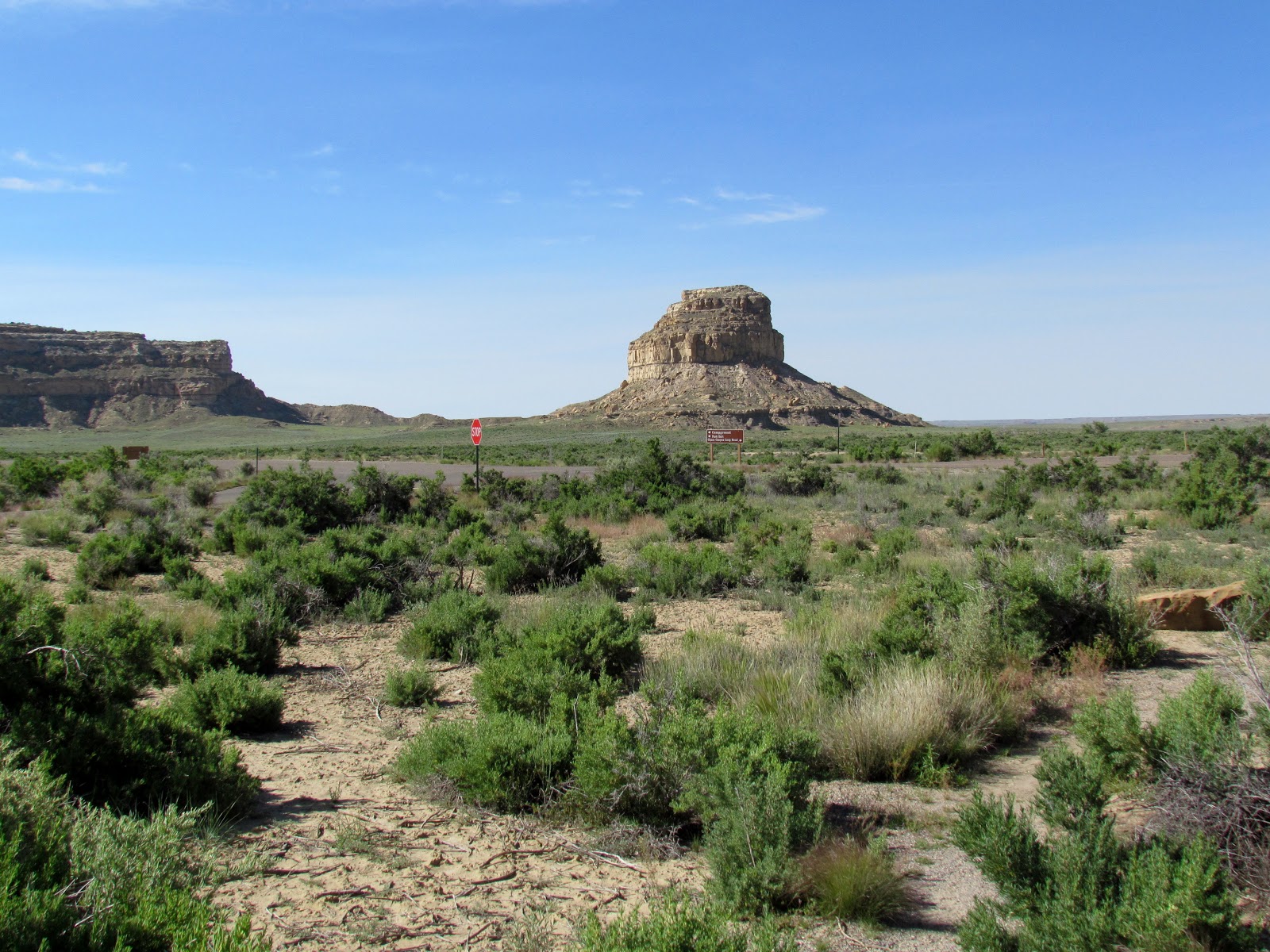
first views upon entering the canyon

Chaco Canyon was an exceptional chapter in American Indian culture.  The building of this unique Indian cultural center began over 1,000 years ago.  Over 150 Great Houses were built in the region.  A great house being a multi-storied stone buildings with hundreds of rooms.  Pueblo Bonito contained over 800 rooms four and 5 levels high.  They are considered large public architectural structures that were not the main centers that the communities lived in, but rather gathering centers for commerce, ceremonies, administrative and cultural exchange.  Most were built in the shape of a large D with a central courtyard, taking decades to centuries to complete some of them.

Hungo Pavi, Great House


Hungo Pavi, Great House


To build such a large cultural center in the middle of a desert canyon where there is little water and high temperatures during the summer months seems to have been dictated by the belief that this was the center of their creation and universe.  Many of the structures are aligned with the celestial stars and seasonal sun cycles.  Multiple straight roads were built leading to Chaco Canyon with many going straight up the canyon walls, stairs being carved into the sides of the canyon walls.

The precise stone cut walls are a unique design in building for the Native Indians.  Timbers were cut and carried over many miles from forests as far as 50 miles or more distance.  Each time I come back to an archeological and historical place like this I learn a bit more about the culture, lifestyle and peoples of this country.

Pueblo Bonito, Great House


it's like looking back in time
1,000 years ago when Pueblo Bonito, Great House
was first built


one of many large Kiva's in Pueblo Bonito, Great House
these large underground round rooms would have had a roof
over each of them

A couple weeks ago, I had the pleasure of meeting Dr Patricia Crown of the University of New Mexico while visiting Bandelier National Monument.  She told me at the time that she had recently been working on a dig at Chaco Canyon.  That excavation at Pueblo Bonito room 28 helped to expand the knowledge of Chaco Canyon.  Back in 1896 the Hyde expedition discovered the largest cache of cylinder jars found at any site.  Through the research done by Dr Crown and Dr Hurst, it was discovered that the tall narrow jars were chocolate drinking jars.  The cacao or chocolate was imported from central Mexico and probably only used for high ranking ceremonies.  Trade with that part of the world has been documented by the discovery of Macaw, and Parrot feathers and skeletons, copper bells, shells and other items from Mexico.
a large Kiva, 4 large posts would have held up the roof

Pueblo Bonito, Great House


Pueblo Bonito, Great House

Pueblo Bonito, Great House, with over 800 rooms

Pueblo Bonito, Great House and a height of  5 stories


The majority of the items recovered during archeological digs are now in a museum in New York, the Smithsonian in Washington D.C. and the Maxwell Museum at the University of New Mexico.  The newly built visitor center in Chaco Canyon has been stripped of all of it’s displays and artifacts (which I happened to see on my previous visit) as they are in the process of returning any artifacts back to the Native ancestors who may wish to make a claim for any of the items.  They tell me that new cultural displays will not be installed until 2017.  Leaving a blank canvas, waiting to tell the story of this high moment in the Chacoan Indian evolution and the Native American Indian.

the new visitor center, empty after removing all the museum
displays

Having always enjoyed architecture, this place brings the imagination into full throttle.  Thinking how this was all being built over 1,000 years ago and completed within a 300 year span of time before gradually being abandoned.  These large stone buildings would have been covered in what is now believed to be an adobe plaster that was probably white.  Making each Great House stand out against the high canyon walls of tan and sandy colored sandstone.  The intricate stone work hidden from the viewer.

now that's a balancing act


Pueblo Del Arroyo

Pueblo Del Arroyo

Many of the great houses that are visible today are only partially excavated, with many of their rooms and and first or second levels still buried by desert sand.  Numerous other great houses appear as only mounds of sand on either side of the canyon.  Archaeology today does not at this time believe in excavating these ruins.  But rather use various radar and imagining techniques to see what is beneath those mounds of sand.


The mysteries still to be discovered at this site are beyond imagination.  Now that’s what I call an adventure worthy of exploring for any traveler.  And I’ve had the opportunity to come here twice and yet, I still haven’t visited all the sites in Chaco Canyon.

A few links to Chaco Canyon:

Chaco Canyon Observatory

Chaco Canyon National Park

Chaco Canyon Wikipedia

Today, Navajo, Zuni, Southern Ute and Apache tribes live in the area.  It’s a part of the true west.  Where single wide mobile homes have rows of old tires on their roofs to keep the metal roofs from blowing away or maybe just to keep the noise down in heavy winds.  Where just about every restaurant serves Mexican food along side American and other ethnic foods and always comes with red or green chili.  The only lakes are those created by damming up rivers and gas and oil wells dot the landscape from one horizon to the other.  Your as likely to see mules and donkeys as you are horses.  White trucks come and go all day long heading out to the fields to inspect all those gas wells.

San Juan River, below the Dam

fly fishing

I’ll be enjoying the area through this coming Wednesday before heading north into Colorado where I’ve secured a campsite at the fairgrounds in Durango.

It’s great to be able to share my travel experiences with you and hope you are continuing to enjoy them.

Have a super great day, wherever your own adventure takes you.

More Photos on Picasa